
How to run a listening check at home.
A two-minute check, done most days, gives you the earliest sign when something in your child's hearing has changed. Here's how to run a listening check well, without turning it into a stressful test.
Hearing technology can malfunction – a tube blocks, a battery drains, a setting gets bumped. A cough or cold can change hearing. None of this announces itself. A short, consistent listening check done nearly every day turns "I think he is hearing less well today" into data that show the change clearly. This guide covers the whole practice: why it is worth doing, how to set it up so the results are meaningful, how to get your child ready, and what to do when something seems off.
Our Listening Check app streamlines the process of running listening checks and tracking your child's listening. Read on to understand how to get the most out of regular listening checks.
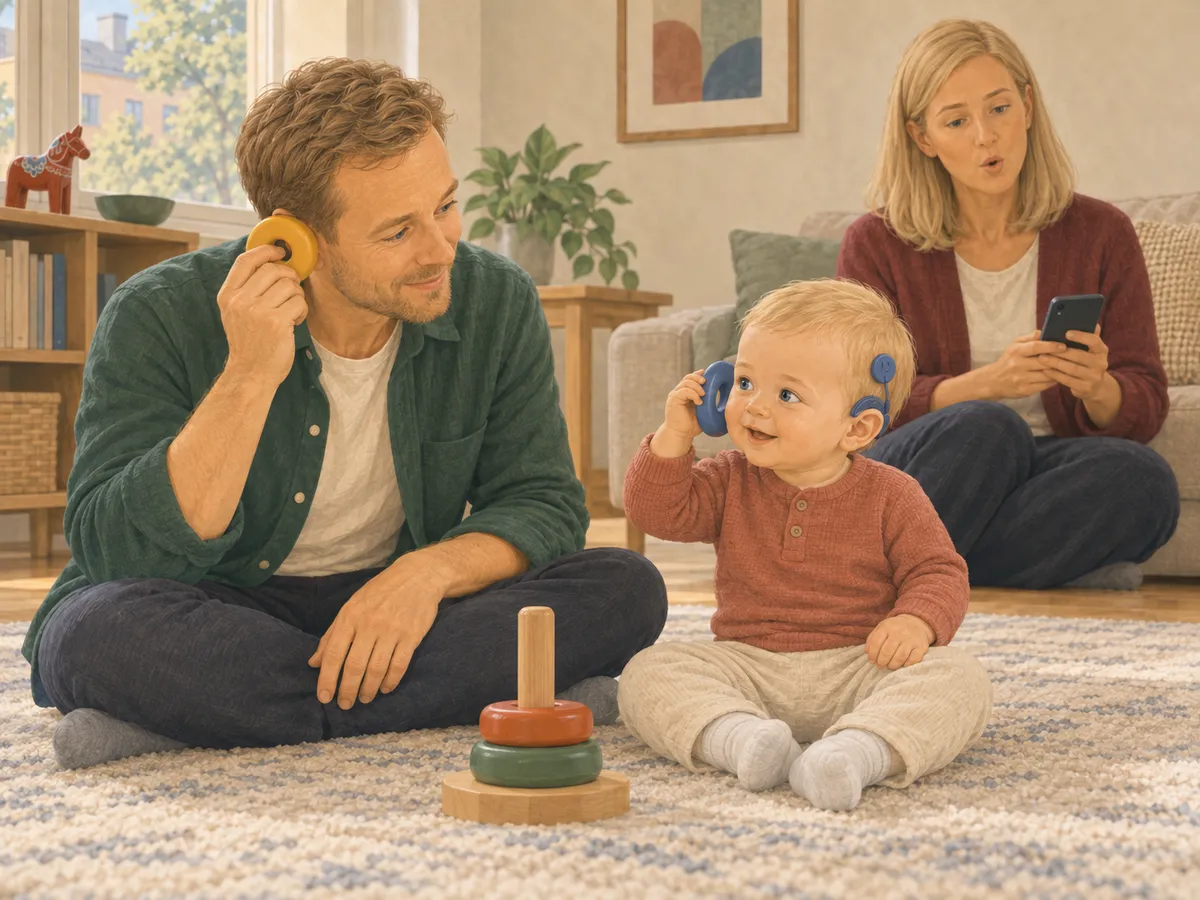
Image description: Fourteen-month-old boy Hugo, wearing bilateral slate-blue cochlear implants, sits on the living room rug holding a blue stacking ring up to his ear, copying his father, Jonas, who holds a yellow ring to his own ear beside a wooden ring stacker, while his mother, Anna, sits behind Hugo holding a smartphone and says a sound for him to listen for, during a listening check in their Minneapolis home.
Hugo and his parents are doing a listening check. Every time Hugo hears a sound, he and papa stack rings on the tower.
Jonas: Listen, Hugo, listen to mama.
Anna: oo oo oo
Hugo stacks the ring on the tower.
Jonas: Great listening, Hugo! You heard oo oo oo.
Why a daily check is worth it
You learn what your child can hear on most days. This tells you which sounds they are hearing and which they are typically missing. For example, if they are missing ss and zz, they are not hearing the difference between singular and plural. "Dog" and "dogs" both sound the same. They will have difficulty understanding and using plurals until they can hear ss and zz.
You catch problems in days, not weeks. Audiology appointments are months apart. You see your child every day. The first person to notice a real problem is almost always the parent. What has been missing is a way to document these changes. Once you've seen twenty days of a particular pattern, a change in that pattern is easy to spot.
Quick and regular checks are better than thorough and occasional. Five two-minute checks every week tell a clearer story than one twenty-minute test at the audiologist every few months.
Consistency is key - aim to do the listening check every morning, for each ear.
But remember, a listening check is not a hearing test. It tells you how your child is listening in the conditions you set up. It does not replace what your audiologist does. A consistent listening check history makes the conversation with your audiologist much more productive, because you walk in with data instead of a feeling.
The five conditions of a good check
A listening check is meant to assess the child's listening on its own, without lip-reading, without guessing from context. The setup matters more than the exact technique. Get the conditions right and the rest is straightforward.
- Quiet. The TV, a fan, the dishwasher all compete with the sounds you're making. Pick the quietest spot you reliably have, and use similar conditions every time.
- Out of sight. Stand or sit behind your child or next to them. Children are very good at reading faces, and a glimpse of your lips is the biggest accidental cheat there is. If you need to sit in front of your child, use a listening hoop to cover your lips, but don't use your hand. Your hand changes the sound.
- Conversational voice. Not loud, not whispered. Say the sounds in an ordinary speaking voice.
- Consistent distance. Start by sitting next to the child. Over time, you can sit at an arm's length or further away and see if they can hear the sounds.
- Wait. Young children with hearing loss often need a few extra seconds to process what they heard. Do not rush them to respond. The waiting will feel longer than is comfortable, but it will be worth it.
Common mistakes worth remembering
- Saying the sound twice in quick succession when there is no response. If there is no response the first time, note it and move on. Come back to this sound at the end. If there is a less than clear response, note it as "unsure" and move on. That is useful information, not a failure.
- Getting closer when responses are inconsistent. Maintain the same distance every time, or the listening checks stop being comparable. However, if you get closer and your child can detect or identify the sound, make a note. This is important to tell the audiologist.
- Checking when the child is tired or upset. Tired listening looks like worse listening. Aim to make this part of the morning routine and again after their nap if needed.
The kinds of checks
There are two common sound sets and three ways a child can respond. You pick one of each, and most families settle into a default and only change it on purpose. That consistency is the point.
The sound sets
- Ling 6. Six sounds (mm, oo, ah, ee, sh, ss) chosen to cover speech from low to high pitch. Fast, universal, and the right starting point for almost everyone. We have a full guide: Ling 6 at home.
- LMH. Ten sounds, from Dr. Jane Madell and Dr. Joan Hewitt, that sample the low, mid, and high pitch more finely. Better when you want a more detailed view of which parts of speech your child gets, and handy when talking through patterns with your audiologist. See Beyond Ling 6: the LMH ten-sound check.
The ways a child can respond
- Detection watches for a reaction: Did the child hear something? Your child shows a sound was heard, by raising a hand, dropping a block in a bucket, or through any other action. This works at any age, including with very young children. It tells you: is sound reaching the brain at all?
- Identification looks for a match: Did the child know which sound it was? Your child points to the picture or toy that goes with the sound. Your child has to know the pairings already, which is why the practice up front matters. It tells you: is the sound heard clearly enough to be recognized, and not confused with other similar sounds?
- Repetition adds speech: Can the child say the sound back clearly? Your child repeats the sound. The most demanding, because it is listening followed by speaking. Best when your child's speech is clear enough for each of the sounds that you can tell which sound they meant to make. It tells you: was the sound heard clearly enough and said back clearly?
Most children start with a Ling 6 detection check, move to identification once the pairings are solid, and add repetition when their speech allows. You don't have to climb the ladder exactly like this. Pick the type of check that gives you good information today.
Getting your child ready
A detection check works from day one. The other two lean on skills your child has to build first. Building them separately, away from the regular listening checks, is what makes the results meaningful. The routine check itself is not the place to teach identification and repetition.
For identification checks
Your child needs to know which picture or toy goes with each sound before the check means anything. That is not testing. That is vocabulary.
- Start with two sounds that are quite different - ah and mm - and two toys. Add more once those are solid.
- Make the pairing memorable: "mm is the ice-cream sound," "ss is the snake sound."
- Practice with your child watching you. Once they have it, move out of sight for a real check.
- Keep practice short. Maximum five minutes at a time, not twenty.
When your child can point to all the sounds with you in front of them, they're ready for a listening-only check.
For repetition checks
Your child needs to be able to say the sounds you're checking. If "ss" and "sh" come out the same when your child says them, you won't be able to tell what they heard.
- Listen to your child say each sound on its own. Can you reliably tell which is which?
- For sounds that are not clear yet, use matching for those specific sounds.
Keeping notes that mean something
However you log it (a notebook works; the SparkMinds Listening Check app does this for you and generates a report for your child's team), three habits make the notes useful:
- Score each sound the same way. Yes: your child responded. Unsure: there was a response but you can't tell whether it was to the sound. No: no response. "Unsure" is not a worse answer than "no." It is a different one, and over weeks the differences tell their own story.
- Note the setup. Sound set, response type, distance, which ear or device, and whether a remote microphone was on. A miss from across the room means something different from a miss at arm's length.
- Compare like with like. Patterns only show up when the conditions are held steady. That is the whole reason for the same room, same distance, same time of day.
These notes are the bridge to your child's team. "He has missed ss at arm's length, left ear, four checks running" is something an audiologist can act on at the appointment, sometimes with a specific programming change. Your feeling that something's off is real, but the pattern they can see in data is better.
When something seems off
Off results almost always mean something physical (a device, a setting, an ear) before they mean your child's hearing has changed. Start with what is easy to check and work outward. Most off checks have a boring explanation. Boring explanations are good news.
1. Look at the device.
- Is it on? Most have an indicator light or a beep on power-up.
- Is the battery fresh, or fully charged?
- Is the ear mold seated properly? A loose mold whistles and lets less sound through. Children's ears grow, and molds need refitting.
- For cochlear implants: is the coil sitting on the magnet? Is the cable connected at both ends?
2. Look in the ear.
- Wax. Very common in young children. Worth a look weekly.
- A recent cold or ear infection? Fluid in the middle ear can drop listening for days, sometimes longer. It usually clears on its own. If it does not, see your pediatrician.
3. Look at the setup.
- Is the room noisier than usual? Fan, TV in the next room, loud conversations close by?
- Did the device get bumped to a different program? Many have a button on the back that cycles.
- Is the volume where it usually is? Children, siblings, and pockets all change settings.
4. Re-run the check. Same room, same distance, same ear, same time of day if you can, and compare against your recent notes for the same setup.
A single off check is a blip. A pattern over three or four checks is a signal. Do not worry about one. Do not ignore four.
When to call your child's team
- Two or three checks in a row lower than usual, with no obvious physical cause.
- Whistling that won't stop when you re-seat the mold.
- A sudden change rather than a slow drift.
- Pain, drainage, or your child pulling at the ear.
You know your child. If something feels different, even without clear data to point at, that is worth a call. Audiologists would rather hear from you early than late. And on the many days when everything's fine, let yourself off the hook. A missed check once in a while is OK.
What we do at SparkMinds
Our Listening Check app turns everything above into a guided, two-to-four-minute routine: it teaches the setup, walks you sound by sound, logs the responses, and tracks patterns by sound and by setup over time, all stored privately on your phone.
If you'd like the same supportive, structured approach across the rest of the day to help you build your child's language, that is what the main SparkMinds app is for.
If you'd like early access to the Listening Check and SparkMinds apps, join us as a Founding Family.
Learn more
 ArticleHow to Practice Daily Listening Checks With Ling 6 SoundsYou might’ve read articles about it, heard your early interventionist explain it or seen a video example showing it, but what exactly is a listening check and why is it important? Read below to learn about listening checks and how you can pract...hearingfirst.org(external link, opens in a new tab)
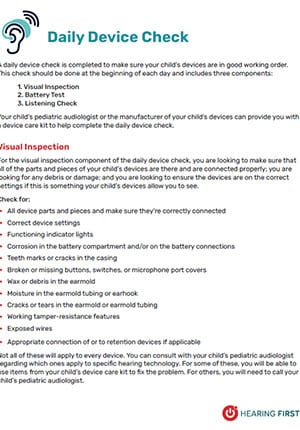 ArticleDaily Device CheckThis helpful handout will guide you through checking all aspects of your child's hearing devices.hearingfirst.org(external link, opens in a new tab)
 ArticleThe Ling Sound Check | Central Institute for the Deaf BlogThe Ling sound check gives you a quick and easy tool to check on a child’s ability to hear spoken language daily.professionals.cid.edu(external link, opens in a new tab)
 ArticleThe LMH Test For Monitoring Listening - Jane Madell and Joan HewittToday’s blog discusses a new test for monitoring listening developed by Jane Madell and Joan Hewitt We know that it is essential that children with hearing loss hear very well with their technology if they are going to be able to use listening to learn language and develop good literacy skills. That is the reason Dan Ling developed the 5 ...hearinghealthmatters.org(external link, opens in a new tab)