
Beyond Ling 6: the LMH ten-sound check.
When six sounds aren't quite enough detail, ten sounds, grouped by low, mid, and high frequencies, show you the shape of your child's hearing across the speech range. Here's when LMH is worth the little bit of extra time.
If you already run the Ling 6 check at home and want a finer understanding of your child's hearing, the LMH check is the next step up: ten sounds instead of six, sorted into low, mid, and high pitch so patterns are easy to see. It takes a little bit longer to run but is worth it in specific situations. If you haven't started with Ling 6 yet, start there first: our guide is Ling 6 at home.
Our Listening Check app streamlines the process of running listening checks and tracking your child's listening. Read on to understand how to get the most use out of LMH listening checks.
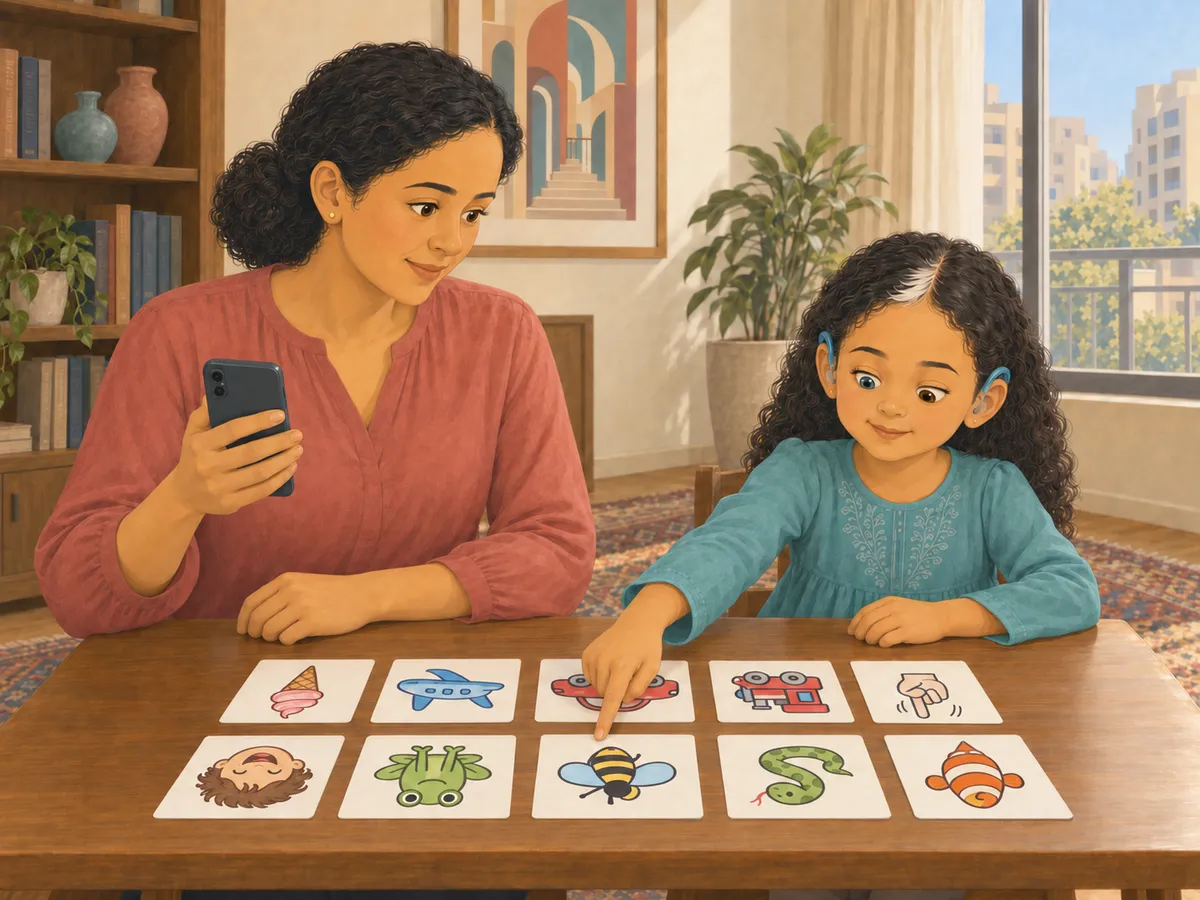
Image description: Five-year-old Egyptian girl Yasmin, who has Waardenburg syndrome with one blue-gray eye, one brown eye and a white forelock, wearing bilateral turquoise hearing aids, points to a picture card among two rows of sound-association cards on the table during a listening check at home, while her mother, Salma, sits beside her holding a smartphone and watches, in the living room of their Cairo apartment.
Salma does a quick LMH identification listening check with Yasmin before school.
Salma: ss ss ss
Yasmin points to the snake.
Salma logs the response as Yes in the Listening Check app.
Salma: zz zz zz
Yasmin points to the bee.
Salma logs the response as Yes in the Listening Check app.
The LMH test comes from Dr. Jane Madell and Dr. Joan Hewitt - both pediatric audiologists. They took the six Ling sounds and added four more ("n," "h," "z," and "j") so that each part of the speech range gets more than one sound. It works on the same idea as Ling 6, say a sound and see whether it lands, but with ten sounds spread across the range and grouped so patterns stand out.
What "low, mid, and high" means
LMH stands for Ling, Madell, Hewitt, but is also a nice acronym for Low, Mid, and High: three bands of pitch where the information in speech lives. Low-pitched sounds carry the hum and shape of vowels. High-pitched sounds carry the fine detail that separates sounds - for example "fish" from "fit." The ten LMH sounds are spread across these three bands, so after a check you can look at the pattern by band rather than sound by sound.
A child who does well on low and mid but misses high has a recognizable pattern. So does a child who's the opposite. The point of LMH is to make those patterns visible. Ling 6 covers the same range, but with only six sounds it groups the pitches more coarsely. If you want to see whether your child hears the top of the high band as well as the bottom of it, LMH was designed to make that clear.
When LMH is recommended
- Your child can sit through a slightly longer check. Ten sounds take a little more focus than six. Preschool children usually manage it comfortably.
- Ling 6 check is showing a consistent pattern and you'd like to look more closely at any small differences under the surface.
- You want more in-depth insight into what sounds your child can differentiate and identify. This is crucial for clarity in speech, learning phonics, and listening in noise.
- You're tracking a device change. After a programming appointment, you want more detailed information about how hearing has changed. LMH gives you exactly that.
When Ling 6 is still the better choice
- Young children with a short attention span. Six sounds in two minutes is easier than ten sounds in three.
- Your first runs. Get Ling 6 stable before adding LMH.
You don't have to choose once and stick with it forever. If you are short on time today, just do a quick Ling 6 check. Keep the two sets in separate notes so each pattern stays easy to read on its own.
How to run the LMH listening check
Do the checks consistently. One LMH check tells you less than a small run of them does. Five checks over a couple of weeks, in similar conditions, will tell you more than ten scattered ones across months.
The conditions are the same as any listening check: quiet room, out of your child's sight, conversational volume, then wait. Say each sound three times in a row, "sh-sh-sh," with a short pause between. That little repetition gives your child a fair chance to catch the soft sounds without turning it into a high-stress drill.
Use the Listening Check app to guide you and log responses. If you don't have the Listening Check app, maintain a physical log sheet of the ten sounds and note your child's responses.
What we do at SparkMinds
Our Listening Check app helps you run both Ling 6 and LMH, shows you each sound right before you say it, and keeps each set's history separate so the patterns stay clear, all stored privately on your phone.
If you'd like the same supportive, structured approach across the rest of the day to help you build your child's language, that is what the main SparkMinds app is for.
If you'd like early access to the Listening Check and SparkMinds apps, join us as a Founding Family.
Learn more
 ArticleThe LMH Test For Monitoring Listening - Jane Madell and Joan HewittToday’s blog discusses a new test for monitoring listening developed by Jane Madell and Joan Hewitt We know that it is essential that children with hearing loss hear very well with their technology if they are going to be able to use listening to learn language and develop good literacy skills. That is the reason Dan Ling developed the 5 ...hearinghealthmatters.org(external link, opens in a new tab)
 ArticleLMH Test Update for Monitoring Listening | Jane MadellThere have been a lot of questions about how to present the LMH sounds. I want to try and clarify things. The question people are asking is how to present the /m/ and /n/ sounds.hearinghealthmatters.org(external link, opens in a new tab)
- Research · PDFLING-10 handoutJohn Tracy Center's printable sound sheet.jtcorg-media-library.s3.amazonaws.com(external link, opens in a new tab)