
Reading a listening check: did they hear it, know it, or say it?
Did the sound get in? Did your child know what it was? Could they say it back? Three responses, three different types of checks that give different levels of insight into your child's listening.
A home listening check asks your child to respond to speech sounds, but there are three different things you can ask them to do with a sound: notice it, recognize it, or say it back. These are not three difficulty settings. They are three different questions, and each one tells you something the others cannot. This guide walks through what each response shows you, where it can fool you, and when it is the right tool. If you're new to running listening checks, start with How to run a listening check at home.
Our Listening Check app streamlines the process of running listening checks and tracking your child's listening. Read on to understand how to interpret the listening checks.
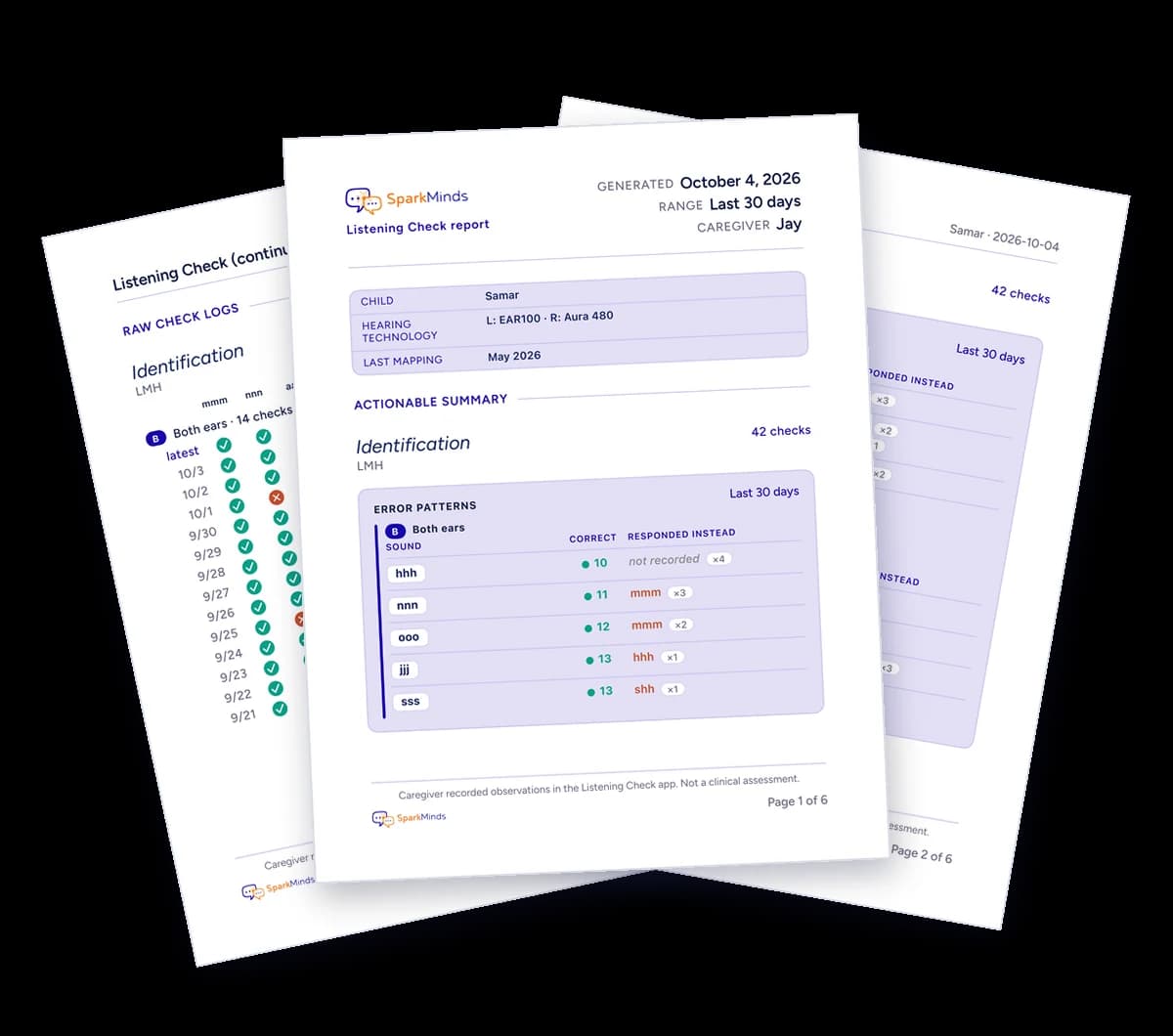
Image description: Three pages of a sample Listening Check report, fanned out on a white background, with page 1 of 6 in front. Its header carries the SparkMinds logo and the title Listening Check report, generated October 4, 2026, covering the last 30 days, caregiver Jay. A panel lists the child, Samar; hearing technology, EAR100 on the left and Aura 480 on the right; and last mapping, May 2026. Under Actionable summary, an LMH Identification section counts 42 checks and shows an Error patterns table for both ears over the last 30 days, giving each sound, how often it was identified correctly and what the child responded instead: hhh, 10 correct, not recorded 4 times; nnn, 11 correct, heard as mmm 3 times; ooo, 12 correct, heard as mmm twice; jjj, 13 correct, heard as hhh once; sss, 13 correct, heard as shh once. The footer reads: Caregiver recorded observations in the Listening Check app. Not a clinical assessment. Behind it on the left, a page of raw check logs lists daily rows from 9/21 to 10/3, mostly green ticks with a few red crosses. Behind it on the right, page 2 continues the error patterns.
A sample report from the Listening Check app: a month of LMH identification checks, ready to share with your child's team.
View the full sample report (PDF)The three questions follow the order that listening itself develops, a ladder that the audiologist Norman Erber described in the 1980s and that professionals still use: first a child notices a sound (detection), then tells sounds apart (discrimination), then recognizes them (identification), then understands (comprehension). A home check focuses on the first few rungs, ensuring that the child is ready to listen, understand, and learn.
Detection: did the sound get to the brain?
This is the first step. Before a child can recognize a sound, they have to notice it. And unlike the rungs after it, a detection check works at any age, including with a six-month-old.
What it shows you
Awareness. A response, any clear response, means the sound made it through the device, through the ear, and into your child's brain and got their attention. It does not tell you whether the sound was clear to your child, just that they noticed it.
That sounds modest. It is not. A child whose brain is still not listening to sound will not react to it. A child whose ear mold is loose will react on and off. A child whose device is not functioning will not react at all. A child whose hearing is limited will notice only some sounds. A child whose hearing has shifted will start missing some sounds that they were noticing. A detection check catches all of that first, which is exactly the kind of pattern an audiologist can act on and make sure that all the sounds are getting to the brain consistently.
How children respond, by age
- Babies and very young toddlers. Watch for a change: a head turn, a pause in play or even body movements (sucking, crawling, etc.), eyes widening, a smile or a scrunched up face. Some will even make a sound in response to what they hear. You have to be the keen observer. Babies do not give a fixed response every time.
- Toddlers and preschoolers. Make the response a game: have them drop a block in a bucket, put a peg in a board, put a sticker on a page, jump in place - when they've heard each sound.
- School-age children. A spoken "yes", a hand-raise or "I heard it" is enough.
The right response is whatever your child can do without thinking about it. The response should not be the hard part of the check.
Where a detection check can fool you
- Your face. A child watching you can "hear" sounds you did not make. Stand or sit behind them, or next to them. Or use a listening hoop. Never cover your mouth with your hand - it affects the sound.
- Rhythm. If you present sounds in a steady rhythm, children learn the beat and signal for the next sound regardless of whether you make it. Vary the timing.
- Eagerness. Some children, especially after lots of cheering, will signal even without a sound. Slip in the occasional silent gap. If they indicate "hearing" when you haven't made a sound, the check is not telling you much.
- Tiredness. A worn-out or distracted child may not respond to sounds they hear perfectly well. If responses are patchy and everything else is normal, the answer might be "try again after a nap," not "something's wrong."
When is it time to move beyond detection checks?
Once the child is a bit older, and when detection checks are reliably clean across all the sounds, several checks in a row, that is your cue to think about whether identification would tell you more. A detection check never stops being useful (it is still the fastest way to catch a device problem), but you can replace it with a more informative check.
Identification: did your child know which sound you made?
A detection check tells you the sound got in. An identification check tells you it got in clearly. The two are not the same, and the gap between them is where a lot of useful information lives.
What an identification check shows you
Telling sounds apart. To point to the snake when you say "ss," your child has to notice the sound, recognize it as different from the other sounds they know, and link it to the right toy. A slip at any step shows up as a wrong answer, and that is the value of matching: "wrong" tells you more than "missed."
If your child reliably points to the snake for "ss" but sometimes also for "sh," that's a useful signal. Two quiet, high-pitched sounds blurring together is a different problem from not hearing either, and it is exactly the kind of specific observation your audiologist or therapist can work with. "She mixes up ss and sh at arm's length" can start a programming conversation.
The pairing problem
Matching depends on your child already knowing which picture or toy goes with which sound. That is vocabulary, not listening, and if you skip the practice you'll be testing memory instead of hearing. The cleanest results come when every sound has exactly one toy the child reaches for, the pairings have been practiced–with you in front of the child–until they are automatic, and the toys or pictures are distinct enough that the child is not second-guessing the target itself.
Pick pairings that are concrete and familiar (a snake for ss, an ice-cream cone for mm, a sleeping baby for sh). While professionals might suggest the toys they commonly use, follow your child's interest and what toys you are comfortable with. Some children are afraid of snakes; you can pick something else for ss. And once you've settled on a set, let your professionals know so you can all use the same set of toys. Practice in short point-and-name games, separate from any check, so the check itself stays a clean measure of listening.
Where a match can fool you
- Process of elimination. With six pictures, a child who knows five can find the sixth without really hearing it. Present the sounds in a random order so elimination is not an option.
- The favorite. If your child loves ice cream, they'll point to the ice cream when unsure. Watch for one target getting more than its share.
- Checking with you. If your child glances at you before pointing, they are using you as a clue. Stay behind them, or out of view, or if using a listening hoop, keep your expression neutral.
When identification is the right tool
Identification is the workhorse check for children old enough to point reliably. It earns its place when detection checks are consistently clean but you want more detail, when you're tracking a programming change and want to know whether sounds have become more distinct. It's also useful when your child's speech is not yet clear enough for saying each sound back. Many children stay on matching for years, including children whose speech is well developed, because it asks a question that saying-it-back does not quite answer.
Repetition: could they say it clearly?
A detection check asks if the sounds got in. An identification check asks if the sounds got in clearly enough to tell apart. Repetition asks to hear the sound, remember it, and say the sound clearly. That is listening plus speech plus self-monitoring, three skills in one check.
What repetition shows you
The whole loop: hear it, hold it in mind, say it. When your child says the sound back clearly, you know it made it all the way through with enough detail to be rebuilt. When it does not come out clean, the question gets interesting: was it the listening, or the speech?
That ambiguity is this check's strength and its weakness. Used well, it tells you more than any other check. Used badly, it tells you nothing, because you cannot pull the two apart.
The speech problem
If your child cannot yet say "ss" without it coming out as "th," then asking them to repeat "ss" is going to look like they did not hear it, even if they did. The check failed for the wrong reason. The honest fix:
- For sounds your child says clearly, saying it back gives you the richest picture of any check.
- For sounds still in progress, use matching. Mixing the two is not a compromise. It is an in-between step.
- If you're not sure whether a sound is in your child's speech yet, ask them to say it on its own (not as part of a check) and listen. If you cannot tell what they meant, that sound is not ready for saying it back.
Documenting the responses
Three answers, same as any check: yes (you'd have recognized the sound without any context), unsure (they said something, but you cannot be confident it was the right sound), and no (no response, or clearly the wrong sound).
Here "unsure" is often genuinely informative rather than a fence-sitter. "Ss, but a bit th-ish" is telling you something specific about your child's listening or their speech. Logging it as unsure, rather than guessing yes or no, keeps the pattern honest, and it is exactly the kind of detail a speech-language pathologist will want to hear about.
When to step back
If three or four checks in a row are coming out mostly unclear, the check is not telling you what you want to know. Go back to identification on those sounds and keep repetition for the ones your child has solidly. You are not losing ground. You're choosing the right tool for the right sound.
The pattern is what you bring to the next appointment
Whichever check you use, the value is in the data over weeks, not any single day. A child whose responses drift from yes to unsure to no across three weeks is a different story from one who has a single scattered off day, and both are stories your audiologist can read at a glance if you bring the data along. That is the quiet payoff of doing this at home: you walk into the appointment with a pattern, and the appointment is more fruitful.
What we do at SparkMinds
Our Listening Check app guides all three kinds of response, keeps each setup's notes separate so comparisons stay clear, and creates reports so that the patterns are obvious when you or your child's team look at them.
If you'd like the same supportive, structured approach across the rest of the day to help you build your child's language, that is what the main SparkMinds app is for.
If you'd like early access to the Listening Check and SparkMinds apps, join us as a Founding Family.
Learn more
 ArticleErber's Hierarchy: The Listening Ladder - Elizabeth A. RosenzweigHow do we take a new listener from hearing beeps at their cochlear implant activation to enjoying the whole wide world of sound?auditoryverbaltherapy.net(external link, opens in a new tab)
 ArticleSupporting Auditory Skills Development at Home | Boys Town National Research HospitalFind a PhysicianPediatricsSpecialty CareHospital CareFor Patients For Physicians531-355-1234Knowledge CenterSupporting Auditory Skills Development at HomeSupporting Auditory…boystownhospital.org(external link, opens in a new tab)
 ArticleAuditory Development Series: Auditory Development Hierarchy -Article 15458Transcript of a webinar outlining an auditory therapy approach that addresses a hierarchy of auditory/receptive language levels. It includes discussion of specific goals and strategies and how they may be targeted in purposeful play.audiologyonline.com(external link, opens in a new tab)
 ArticleHow to Practice Daily Listening Checks With Ling 6 SoundsYou might’ve read articles about it, heard your early interventionist explain it or seen a video example showing it, but what exactly is a listening check and why is it important? Read below to learn about listening checks and how you can pract...hearingfirst.org(external link, opens in a new tab)