
Your baby didn't pass the hearing screening. Here's what happens next.
A "refer" result isn't a diagnosis, and it isn't the end of any story. Here's what it really means, the one thing to do this week, and how to be gentle with yourself while you wait.
If your baby had a hearing screening and you are holding a slip that says "refer" or "did not pass" or "no clear response", start here: this is not a diagnosis of hearing loss. It doesn't mean your baby is deaf. It means the screening couldn't confirm normal hearing on that day, in that room, and your baby needs a closer look.
Many babies who refer turn out to hear just fine.
And even those who are diagnosed with hearing loss learn to listen, speak, read and reach their full potential, when they have an early start with the right professional support and parents like you.
By the end of this 10-minute read you'll know:
- What the result actually means.
- Exactly what should happen next–in the country where you live.
- The one thing you should do this week.
- What to hold on to if the answer, after the follow-up test, is hearing loss.
Only have a minute? Jump to the box and select your country to learn the one step that is urgent.
What happens next where you live
Hearing programs everywhere aim for the same timeline, often called 1-3-6: screening done by 1 month, a full hearing test by 3 months, and support by 6 months if it's needed. The process, professionals, and costs for each step depend on your country.
The follow-up system depends on your country.
In the United States
What your result means in the United States
"Refer," "did not pass," and "fail" all mean the same thing - your baby's hearing needs a closer look. After a repeat screen, fewer than 2 in 100 babies still need a full hearing test, and about five in six of those turn out to have typical hearing. Permanent hearing loss is found in roughly 1 to 2 of every 1,000 babies.
If you are told to get your baby's hearing checked, please schedule the appointment. Knowing what your baby can hear is better than wondering if your baby can hear.
What happens next
Every state runs an Early Hearing Detection and Intervention (EHDI) program.
- Rescreen by 1 month, at the hospital or your pediatrician's office. Many babies pass here.
- Full hearing test by 3 months, with a pediatric audiologist to identify how much the baby is hearing with each ear. If hearing loss is diagnosed the audiologist can talk to you about considering hearing aids or cochlear implants so your child can start hearing as soon as possible.
- Early intervention by 6 months, if a baby has hearing loss, through your state's Part C program. You can receive home-based early intervention sessions with a speech-language pathologist or a teacher of the deaf. You can call and request services yourself; no referral needed.
Cost. The screening is usually covered with no copay. The full test is billed as a diagnostic visit, so deductibles or copays can apply. Medicaid and CHIP cover testing, hearing aids, and cochlear implants for children, and early-intervention evaluation is free. Some states also offer a quick CMV test after a failed screen; say yes if asked.
Your one thing this week
Book the follow-up. If there's no appointment on your discharge papers, call the hospital or your pediatrician. Don't wait to be called. Ask for an appointment within the next 3 weeks.
- If the wait is longer than that, ask to be put on a cancellation list and check with other audiology practices nearby as well.
- If you have a parent support group or a Hands and Voices chapter in your state, reach out to them. They might be able to guide you to an audiologist who will see you quickly.
Who can help
The phone number on your slip, your pediatrician, then your state's Early Hearing Detection and Intervention (EHDI) program(external link, opens in a new tab). Hands & Voices is a parent-led group that offers parent-to-parent support(external link, opens in a new tab) and has state chapters(external link, opens in a new tab) that you should contact.
In India
What your result means in India
Your report probably says "Pass" or "Refer" for each ear, or "OAE not passed." OAE is the quick test most Indian hospitals use. Refer results are common in India, often 5 to 20 in every 100 babies, mostly because babies go home soon after birth, before the ears have cleared. Most pass the second test. Indian studies find permanent hearing loss in roughly 6 of every 1,000 babies, more among babies who needed neonatal intensive care.
What happens next
India has no single national early intervention programme yet, so the route depends on where your baby was born, and you may need to drive it yourself.
- A repeat OAE by 4 to 6 weeks. Sooner is better.
- A BERA test by 3 months if the repeat test also refers. A BERA test, also known as an ABR, is a test for checking a child's hearing when they are sleeping. Babies who are in the NICU are always referred for a BERA test.
- Hearing aids and therapy before 6 months, if needed. If hearing loss is confirmed, assistance is available to eligible families through state and national government schemes, for example ADIP(external link, opens in a new tab), and through private foundations. Your audiologist can tell you about it.
If your baby was born in a private hospital: your paediatrician will tell you where to go. Testing is paid and prices vary, so ask first. Ask if the ENT and audiologist you will see have experience with young babies.
If your baby was born in a government hospital: you can connect with the District Early Intervention Centre (DEIC) at your district hospital, part of the RBSK programme. Its services are free, though not every district has one yet. Government medical colleges, AIISH in Mysuru, and AYJNISHD in Mumbai also do BERA. Kerala runs its own screening in government hospitals.
Your one thing this week
Book the repeat test. Ask your paediatrician today: "The OAE said refer. Where do we get the repeat, and who does the BERA?" If the paediatrician doesn't know the answer, check with the government hospital. In either case don't wait. Early diagnosis is crucial for future success.
Who can help
Your paediatrician, an ENT doctor, and an audiologist. A qualified audiologist is registered with the Rehabilitation Council of India, and it's fine to ask for the number or check the register(external link, opens in a new tab). AIISH answers questions on 1800-425-5218. Several regional organizations have helplines that provide more information. Ask your professional team to connect you with other families and parent groups.
In one survey of North Indian parents, nine in ten thought the follow-up test wasn't needed. Often grandparents doubt the need for additional testing or want to wait. Their view often carries real weight, especially on travel and money for appointments, so share that the BERA test will resolve any doubts and bring them along for the testing. And if you hear older, unkind words for deafness, even on official forms, they're simply outdated. A deaf child is fully able to communicate, learn, and thrive.
In Australia
Coming soon
Parents: We're still checking the details for this country. Until then, the general guidance under “Somewhere else” walks you through the steps that are common in most places.
Professionals and Parent Leaders: If you are working in this country and want to help us verify our information related to newborn hearing screening and follow-up in your country, please connect with us.
In Austria
Coming soon
Parents: We're still checking the details for this country. Until then, the general guidance under “Somewhere else” walks you through the steps that are common in most places.
Professionals and Parent Leaders: If you are working in this country and want to help us verify our information related to newborn hearing screening and follow-up in your country, please connect with us.
In Canada
Coming soon
Parents: We're still checking the details for this country. Until then, the general guidance under “Somewhere else” walks you through the steps that are common in most places.
Professionals and Parent Leaders: If you are working in this country and want to help us verify our information related to newborn hearing screening and follow-up in your country, please connect with us.
In Indonesia
Coming soon
Parents: We're still checking the details for this country. Until then, the general guidance under “Somewhere else” walks you through the steps that are common in most places.
Professionals and Parent Leaders: If you are working in this country and want to help us verify our information related to newborn hearing screening and follow-up in your country, please connect with us.
In Kenya
Coming soon
Parents: We're still checking the details for this country. Until then, the general guidance under “Somewhere else” walks you through the steps that are common in most places.
Professionals and Parent Leaders: If you are working in this country and want to help us verify our information related to newborn hearing screening and follow-up in your country, please connect with us.
In Mexico
Coming soon
Parents: We're still checking the details for this country. Until then, the general guidance under “Somewhere else” walks you through the steps that are common in most places.
Professionals and Parent Leaders: If you are working in this country and want to help us verify our information related to newborn hearing screening and follow-up in your country, please connect with us.
In Singapore
Coming soon
Parents: We're still checking the details for this country. Until then, the general guidance under “Somewhere else” walks you through the steps that are common in most places.
Professionals and Parent Leaders: If you are working in this country and want to help us verify our information related to newborn hearing screening and follow-up in your country, please connect with us.
In South Africa
Coming soon
Parents: We're still checking the details for this country. Until then, the general guidance under “Somewhere else” walks you through the steps that are common in most places.
Professionals and Parent Leaders: If you are working in this country and want to help us verify our information related to newborn hearing screening and follow-up in your country, please connect with us.
In Switzerland
Coming soon
Parents: We're still checking the details for this country. Until then, the general guidance under “Somewhere else” walks you through the steps that are common in most places.
Professionals and Parent Leaders: If you are working in this country and want to help us verify our information related to newborn hearing screening and follow-up in your country, please connect with us.
In the United Arab Emirates
Coming soon
Parents: We're still checking the details for this country. Until then, the general guidance under “Somewhere else” walks you through the steps that are common in most places.
Professionals and Parent Leaders: If you are working in this country and want to help us verify our information related to newborn hearing screening and follow-up in your country, please connect with us.
In the United Kingdom
Coming soon
Parents: We're still checking the details for this country. Until then, the general guidance under “Somewhere else” walks you through the steps that are common in most places.
Professionals and Parent Leaders: If you are working in this country and want to help us verify our information related to newborn hearing screening and follow-up in your country, please connect with us.
Somewhere else
What your result means
The slip may say "refer," "did not pass," "fail," or "no clear response"; they all mean the same thing. Worldwide, roughly 1 in 20 babies doesn't pass the first screen, and most pass the follow-up. Permanent hearing loss is found in roughly 1 to 3 of every 1,000 babies.
What happens next
The World Health Organization recommends the same timeline in every country. Not every program runs like clockwork, so it helps to know the steps and ask for each one.
- A repeat screen within the first weeks.
- A full hearing test by 3 months, with an audiologist who regularly tests babies.
- Support by 6 months, if needed: hearing technology, sign language, or both, led by your family's choices.
Your one thing this week
Find out who is booking the next test, and when. If nobody is, ask your baby's doctor for a referral to an audiologist who tests babies.
Who can help
The hospital that did the screen, your baby's doctor, or the audiology or ENT department of the nearest children's or university hospital. The Global Coalition of Parents of Children who are Deaf or Hard of Hearing(external link, opens in a new tab) lists parent-led groups around the world. More guides for parents, from the first screen to the full hearing test, are in Learn more at the end of this page.
Wherever you are in the world, the rest of this guide applies to you.
What "refer" actually means
The screening is built to be cautious. It flags every baby who might need more testing, so it flags many babies who don't. Common reasons a hearing baby refers:
- Timing. In the first day or two, the ears often haven't cleared yet.
- Vernix or fluid in the ear canal, which can take days or weeks to clear.
- Fluid in the middle ear, common after birth, especially after a C-section, and usually gone on its own.
- A wiggly baby or a noisy room. The test needs stillness and quiet.
None of this is anyone's fault. Nothing you did or didn't do causes a refer result. "Refer" is the screening saying "I couldn't be sure." It isn't the screening saying "something is wrong."
Your baby probably hears, and the follow-up still matters
It's tempting, especially when relatives reassure you, to let the appointment slide. "He startles when the dog barks." "He'll grow out of it." But babies can startle at loud sounds even with significant hearing loss, so watching at home can't settle the question. Only the follow-up can.
Both answers are good to have early. If your baby hears, you can put that worry out of your mind for good. If your baby has some level of hearing loss, finding out in the first few months, rather than in the first few years, is one of the biggest gifts you can give them. Children who are diagnosed and supported early have much stronger language and literacy skills, and many keep pace with their hearing peers. The follow-up isn't going to create bad news. It's going to create clarity, and clarity lets you create a better future for your child instead of wondering.
What the full hearing test is like
Almost everywhere, it's a diagnostic ABR (auditory brainstem response; in India, BERA). Conducted while your baby sleeps, the ABR places soft sensors on their skin and gentle sounds play through tiny earphones. It shows whether there's hearing loss, in one or both ears, and how much. No needles, no pain, and you are still right there.
Young babies sleep through the ABR test most easily, which is one more reason not to wait. Bring feeds, a change of clothes, and someone to keep you company if you can. If your baby was in neonatal intensive care, they may go straight to an audiologist instead of another screen. That's standard practice, not a sign of anything more serious.
If the answer is hearing loss
If the follow-up has already happened and the answer wasn't the one you hoped for, this section is for you.
Your baby is the same baby they were the day before the diagnosis. What changed is that you know something important early. That puts your family in the strongest possible position.
- Early diagnosis changes the story. Babies identified in the first months and supported through family-centered early intervention can build language on the same timeline as their hearing peers, and many do. Your baby was identified early.
- You don't have to decide everything now. Families build language through listening and spoken language with hearing aids or cochlear implants, through sign language, or both. You should take a few weeks, meet families who have made these choices, and decide what works best for you and your child. What matters most in these early months is a strong connection, loving care, and responsive communication from you, in whatever form, every day.
- What you do matters more than the audiogram. Dr. Moeller's landmark study(external link, opens in a new tab) of 112 children found that family involvement predicted language at age five better than the degree of hearing loss did. The back and forth of songs, peek-a-boo, chitchat during the walk to the park, the bedtime story: that's where language is built. You're not a bystander to your child's care. You're at the center of it.
- You won't walk this path alone. Parents a few years ahead of you have walked down exactly this path. One conversation with a parent who's been there often does more than ten pamphlets, and your country's box names groups that can connect you with other families.
For the family members that aren't ready yet
Families rarely arrive at this moment together. One parent researches at 2 a.m. while the other can't yet say the word "deaf." A grandmother insists he'll grow out of it. A grandfather quietly grieves and calls it being practical. None of them love the baby any less; they're each dealing with the news at their own speed.
If you're not ready yourself, that's OK. Grief for the loss of the dream you'd imagined is normal, and it doesn't make you a bad parent. You can be heartbroken and still make the phone call. Acting doesn't require feeling ready, only the next small step.
If you're ready and someone you love isn't, gentleness works better than evidence. Bringing a grandparent to an appointment often does more than any argument. Inviting another parent and their DHH child for tea and chat will answer more questions than a doctor's visit. Give your family members some time, and keep showing them the possibilities.
And to "he'll grow out of it": fluid can clear, which is exactly what the follow-up checks. Permanent hearing loss doesn't, and waiting deprives the baby of the months when their brain is most hungry for language. The loving response to uncertainty is finding out.
What you should do this week
- Make sure the next test is booked. It's the one thing with a clock on it, and your country's box says how.
- Talk, sing, and snuggle as you planned to. Your voice and your answers to every coo are building your baby's brain right now, whatever the result of the follow-up test.
- Write down your questions as they come, 3 a.m. included. One worth adding: "Should my baby have a CMV test?" It checks for a common virus that can affect hearing and also other areas, and the test is recommended in the first three weeks after birth.
- Tell relatives the truth in one sentence: "The screening couldn't confirm his hearing, so we're doing a follow-up test. Most babies pass, and we'll know more on the 14th." It answers the question and closes the topic until there's something real to discuss.
- Let yourself off the hook. You have a newborn. Exhausted, teary, and being behind on everything is allowed.
This isn't a crisis, and it isn't a verdict on you, your baby, or your family. It's one appointment, one week, and paths forward that thousands of families have walked before you.
What we do at SparkMinds
SparkMinds provides personalized daily guidance for families of DHH children using hearing aids or cochlear implants who are building listening and spoken language, with sign language always welcome alongside. That chapter, if it comes, starts after diagnosis, and ramps up once devices are fitted and the everyday work of listening and language begins at home. We're not asking anything of you today. If an occasional, useful note in your inbox would help, you can share your email with us, and if your path leads to hearing technology, we'll be here when you're ready.
For now: make sure the appointment is booked, hold your baby, and let this week be what it is.
Learn more
- ArticleMember organisations | GPODHHGPODHH is an international collaboration of parent groups dedicated to promoting improved systemic protocols and practices which encourage informed choice and the empowerment of families with a deaf or hard of hearing child throughout the world.gpodhh.org(external link, opens in a new tab)
 ArticlePediatric Hearing Evaluation and TechnologyHearing First guide for parents from screening to evaluation.hearingfirst.org(external link, opens in a new tab)
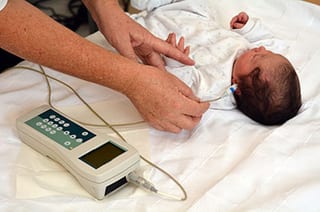 ArticleYour Baby's Hearing Screening and Next StepsMost children hear and listen to sounds at and even before birth. They learn to talk by imitating the sounds they hear around them and the voices of their parents and caregivers. But that’s not true for all children. In fact, about two or three out of every 1,000 children in the United States are born with detectable hearing loss in one or both ears.nidcd.nih.gov(external link, opens in a new tab)
 ArticleHearing Screening for Newborns, Children & Adolescents: AAP Policy ExplainedThe American Academy of Pediatrics on what happens if the repeat screen shows concerns.healthychildren.org(external link, opens in a new tab)