
The magic is in the in-between.
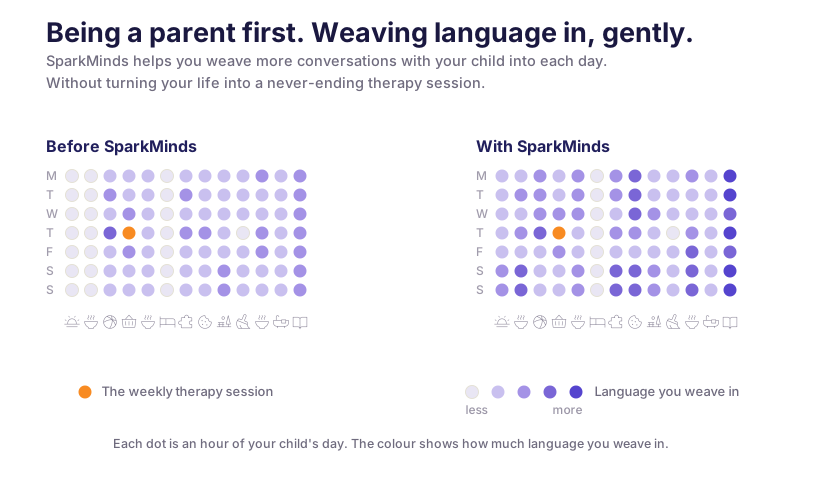
A young child is awake for about 5,000 minutes a week. At most fifty of them are therapy. The language is built in the other 4,950, and you are the one who is there for them.
Every week, professionals like me have fifty minutes to work with a family. Over the last 25 years, I have met for 50 minutes a week with families in-person, online, in our schools, and in their homes. These fifty minutes are precious. Together, the adult, the child, and I work on listening, language, and connection.
The best professionals do not spend these fifty minutes teaching the child. They use those to guide and coach the adults - the parents, the grandparents, the nanny. Because these caring, loving adults are the ones who are there for everything that comes next. In daily life, until the next session, in the in-between.
And the magic of learning happens in the in-between.

Image description: Two-year-old Indian girl Ruhi, wearing a purple cochlear implant, offers a red bell pepper to her mother, Renuka, while her father, Himanshu, lowers the grocery bags beside them just after arriving home in their Bangalore apartment.
Ordinary moments. Extraordinary opportunities.
A young child is awake for a little over five thousand minutes a week. Fifty of them, at most, are therapy. The other five thousand minutes belong to the family.
I could be the best professional in the world, and I still could not do in fifty minutes what those five thousand minutes do. Language is not learned in therapy sessions. Language is learned while living life. It is built in a slow, steady drip: a word, a sentence, a concept, a listening skill, repeated in real moments, with someone the child loves.
A child says "more," and someone they love lights up, and there is more juice, more blocks, more songs and dance. The child discovers the magic of more. And one day soon "more" becomes the best word in the world. That is the in-between, doing its quiet work.
In the past 25 years I have often seen that when I start with a family, the parents have somehow lost their confidence in their ability to make the most of the in-between. They are wondering if they can do enough for their child who now has been diagnosed as having a hearing loss. They are looking to me with hope, as the "expert" - the expert who will make their child talk. But in reality, they are the expert - the expert on their child - the child's likes and dislikes, their strengths and needs. It is my job to help them see their expertise and their capabilities, help them find the joy in the everyday, in the in-between.
To the parents reading this, wondering how you can find your confidence and joy, I have five suggestions for you:
- Treat every sound, look, and gesture as a turn in a conversation, and answer it. Long before the words come, you can have these non-verbal two-way conversations.
- Talk about what is happening, as it happens. Short, clear sentences, about the thing your child is looking at right now.
- Wait. Give your child a few seconds to respond. The pause is where they find their turn. Most of us fill these pauses too quickly, but you can learn to wait.
- Follow your child's lead. Whatever they are interested in this minute is the best thing in the world to talk about. If the child is up for it, join in. Play alongside, play with them. Don't try to take over.
- Use the routines you already have. Breakfast, grocery shopping, the walk to the playground–all are language learning opportunities. Enjoy them over and over, because repetition is how a child truly makes the language their own.
In short: be present, and be intentional. You don't need a curriculum, and you don't need to add anything to your day. These habits build language in any form, spoken or signed. They are not tricks. They are just what it looks like to be tuned in to your child.
But a word of caution - don't overdo it. Don't try to become your child's therapist.
You are your child's parent. That is a bigger job, and a more important one. It is the job only you can do. A child doesn't need a language drill at every meal. They do need a parent who is enjoying the meal with them.
That relationship comes first, always. And no meaningful learning happens without it.
The goal is not to fill every waking minute with a learning opportunity, but to find moments that can be enriched. The in-between is not a lesson that never ends. It's your ordinary life, with a little more language woven through it, on the days you have it in you. On the days you can't, being together is more than enough.
And something I have noticed over the years - the small things that help a child's language development - slowing down, following their lead, waiting, noticing what your child is trying to tell you, tend to make everything else a little easier too. A child who is heard is often a calmer, more engaged child. A parent who has learned to watch and wait feels more connected, less overwhelmed. These strategies are aimed at language. But they are also tuned-in parenting in general. They help you help your child be more of who they are.
My hope for families
If I could give a family more of something, it would not be more therapy. It would be guidance and suggestions that enrich their in-between. That is what we have built.
SparkMinds was built for the in-between: to help families notice the language opportunities present in an ordinary day, and turn a few more of them into a conversation. It works from the goals a child's therapists and teachers are already setting, so the more you practice and notice during the in-between, the more information you have to bring back to the next therapy session. This applies to all spoken and sign languages. Language is language.
If you have a young child using hearing aids or cochlear implants, and you would like company in making the most of your in-between, I would love for you to join us.
—Uma Soman, founder of SparkMinds