
Teach it, practice it, live it.
Every skill your child learns starts as something you teach on purpose and ends as something they do without thinking. Knowing which stage you're in tells you when to guide and prompt, and when to simply play.
Parents of children who are Deaf or Hard of Hearing are often told,
Make sure your child is wearing their hearing technology and just talk to your child. Give them lots of language, play with them, read and sing with them. That is how you can work on all the language skills.
I too have said that, only to realize that this message is still unclear. Parents are wondering,
Am I supposed to be teaching new words right now, or just playing with the dollhouse?
Am I supposed to read a book and enjoy the story or am I supposed to be practicing these new words?
Are we supposed to sing the whole song together or just sing a few words and then wait for my child to sing the rest of it?
The answer depends on where the child is on the continuum of learning a particular skill.
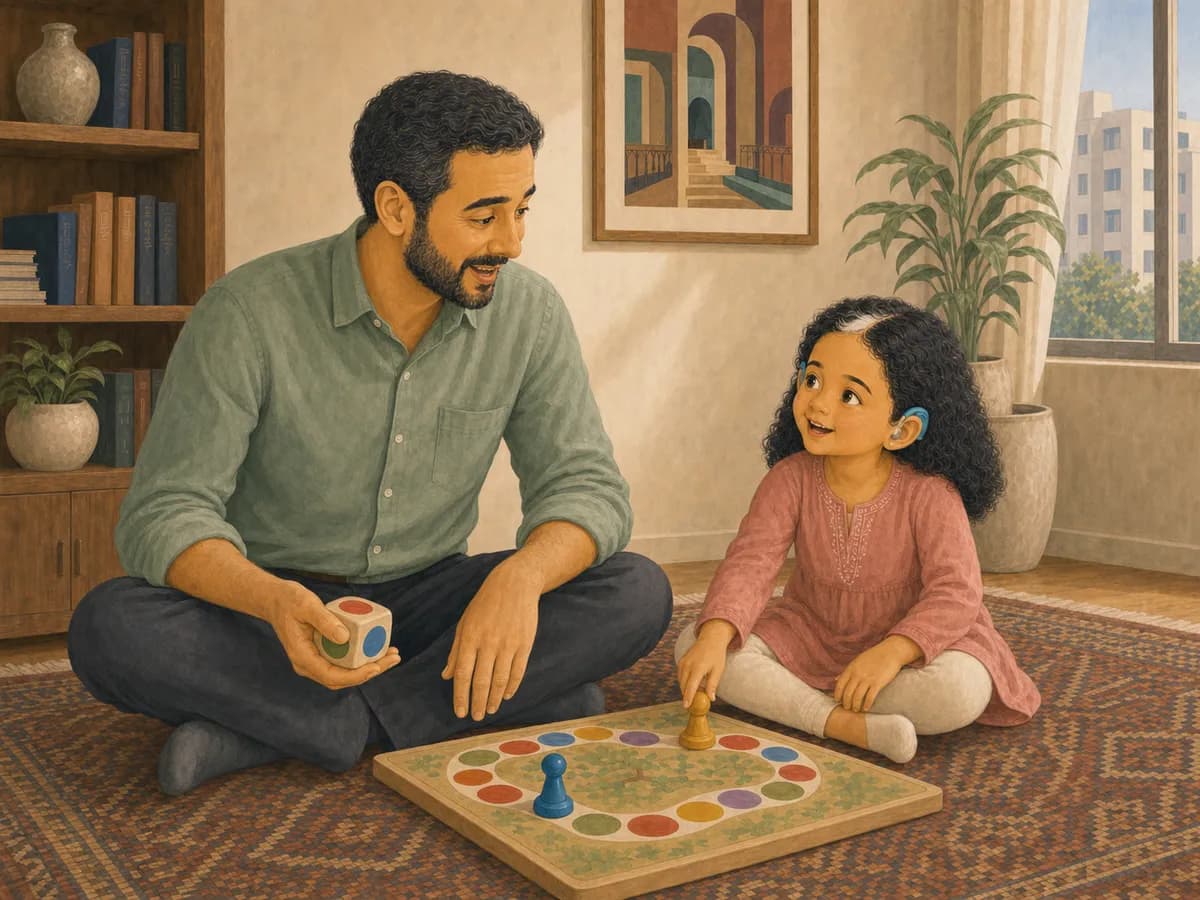
Image description: Five-year-old Egyptian girl Yasmin, who has Waardenburg syndrome with a white forelock and two different colored eyes, wears bilateral turquoise hearing aids and plays a board game with her father, Karim, at home in Cairo.
Ordinary moments. Extraordinary opportunities.
Language is caught, not taught
Think about a hearing child at the dinner table. Nobody is teaching them anything. The grown-ups are talking about the day, the baby is banging a spoon, and perhaps an older sibling is trying to get dessert. None of this is directed at the child, and yet the child is soaking up words, grammar, the rhythm of a conversation, all of it in the background. This is incidental learning. In fact, 4-year-olds have incidentally learned up to 80% of the words they know.
For children who are Deaf or Hard of Hearing, however, "catching" language is not always so easy. Even with well-fitted hearing aids or well-programmed cochlear implants, a lot of the language happening around them–the conversation across the room, the aside in a noisy kitchen–does not fully reach their brains. So we have to make it easier for children to notice and catch the language around them, finding a balance between "just" playing or reading or singing versus doing it with intention. I coach families to do just that in every session.
From "Absent" to "Achieved"
In therapy, at home, and in the SparkMinds app, we track the listening, understanding, and speaking skills that each child is learning. Some skills the child can't do yet, other skills are being used sometimes or with help, and then there are skills the child knows and uses every day without any help from the adults.
In technical terms we are placing each skill on a learning continuum of the skill being "absent", "emerging" or "achieved". Where that skill is on this continuum guides how we are playing and what we are practicing. We have built this approach into SparkMinds. For every skill, we guide parents to Teach It, then Practice It, and finally Live It.
Teach It: the skill is new
When a word, a sentence structure, or a skill is brand new, you lead. You set up a short, playful moment that shows the skill clearly and invites your child to have a go.
Say the new word is "up." You might lift your child onto the bed and say "up!", a little slower, with a little more melody than usual. You do it a few more times, making sure that your child is noticing this new word and how it gets them off the ground! Then you wait. You leave a pause, long enough that it feels slightly awkward to you, because that pause prompts your child to take a turn.
Will they say "up"? Probably! But, if they haven't "caught" up yet, that is okay. Children need many repetitions with sufficient context to learn something new. Try another activity where the child gets to experience "up", maybe a monkey climbing up the tree in a book, or your child climbing up the slide at the playground. After a few experiences with "up", they will catch it!
This is teaching, and it is necessary. But it is best when it happens inside a game, a routine, or with an interesting book.
Practice It: the skill is there, but not every time
Some days your child says "up" with their arms in the air. Some days they just reach and whine. The skill is emerging.
Now your job changes. You create lots of chances for the child to use this skill inside the games and routines you already have: the stairs, the swing, the toy that lives on the high shelf. When the word doesn't come naturally, you nudge, maybe by starting it for them ("u..."). And little by little, you step back. The teaching is still there. It's just a little more hidden.
Live It: the skill shows up on its own
Then one morning your child stands at the bottom of the stairs, looks at you, and says "up!" Nobody set it up. Nobody prompted it.
That is Live It. Your job now is the easiest and the best one: notice it and, at first, praise it. And then expect it in daily life. Live It is also the sign that this skill is done being an active learning goal. It's time to move on to the next one. In the SparkMinds app, you will be prompted to share your progress and mark this skill as "achieved"!
The whole spectrum, at the same time
Your child is never working on just one skill. In any given week, one skill may be brand new and need Teach It, while another is nearly done and only needs a parent who acknowledges it every time it happens. So a good day mixes a little teaching with a lot of ordinary life.
How does the SparkMinds app know how a skill is progressing? Mostly from you. For every activity that the app suggests, we will guide you on what to observe. After the activity, we will ask you how your child did. After a few activities, we will ask if your child is ready to move to the next stage. Parents are the experts on the child. You are there at mealtime, on the playground, and in the middle of the night. That is why we always have parents take the lead on reporting a child's progress.
This is also where the wider early childhood development field has landed. The Division for Early Childhood recommends teaching that is embedded in everyday routines, intentional, and systematic. That is a fair description of Teach It and Practice It, and of why they are meant to melt into Live It rather than go on forever.
What this means for you
So, back to the questions we started with. Are you supposed to be teaching right now, or just playing?
When a skill is new, a few focused, playful minutes inside a routine you already have are exactly right. You are not taking over your child's day. And if the moment wanders off in a different direction, follow your child. That is not failure, that is conversation.
When a skill is in Live It, the teaching is over. Drilling it now would only turn something your child already knows into unnecessary homework. Sit back and enjoy it. You helped build it.
SparkMinds is built around these three stages. It takes the skills your child's therapists and teachers are already working on, and suggests the right kind of moment for each one, depending on where each sits. A little Teach It for a brand-new word. Some intentional support for the grammar that is emerging. And active engagement with the phrases your child is starting to use unprompted.
If you have a young child using hearing aids or cochlear implants, and you would like help knowing when to lean in and when to just enjoy, I would love for you to join us as a Founding Family.
—Uma Soman, founder of SparkMinds
Learn more
- ArticleERIC - EJ1116302 - Teaching Vocabulary to Preschool Children with Hearing Loss, Exceptional Children, 2016-OctDespite poor vocabulary outcomes for children with hearing loss, few studies have evaluated the effectiveness of specific vocabulary teaching methods on vocabulary learning for this group. The authors compared three vocabulary instruction conditions with preschool children with hearing loss: (a) explicit, direct instruction; (b) follow-in labeling; and (c) incidental exposure using an adapted alternating-treatments single-subject experimental design. Nine preschool children with hearing loss participated in the study across 6 weeks, with intervention implemented by 4 teachers of the deaf. Visual analysis of the results of the data indicated that participants learned the most words in the explicit, direct instruction condition and the fewest words in the incidental exposure condition. These results are not consistent with some recommendations currently made to educators. The authors discuss implications for practice, including emphasis on direct instruction.eric.ed.gov(external link, opens in a new tab)
 ArticleAsking About Acoustic Highlighting - John Tracy CenterThe leading diagnostic and education center for children with hearing lossjtc.org(external link, opens in a new tab)
 ArticleRecommended Practices | DECBecome a Member Make a Donation Sign Up for DEC Emails News & Updates | DEC Collaborate - Community Forum | DEC Explore Courses & Modules | Career Center | Store | Be Part of EI |…dec-sped.org(external link, opens in a new tab)
- ArticleThe Hanen Centre - It Takes Two to Talk® Program for Parents of Children with Language DelaysAt an It Takes Two to Talk® Program, you learn how to build your child’s language skills during everyday interactions and activities.hanen.org(external link, opens in a new tab)